Single-cell multi-omics analysis
Our lab works closely together with the Department Dermatology at the University Hospital of Zurich interpreting single-cell and spatial omics data in translational settings. We had several fruitful projects over the past years.
Investigating novel treatment options in therapy-resistant melanoma Our study showed that drug-resistant NRAS-mutated melanoma cells adopt a quiescent, mesenchymal phenotype with elevated reactive oxygen species levels. This metabolic change creates a vulnerability that makes these cells highly sensitive to ROS-inducing agents. Combining a ROS inducer with a MEK inhibitor proved effective in inhibiting tumor growth and metastasis in both xenograft models and ex vivo human samples. (read more here: https://aacrjournals.org/cancerres/article-abstract/83/7/1128/718992/ROS-Induction-Targets-Persister-Cancer-Cells-with)

Elucidating the BCC microenvironment This project utilized immunohistochemical and single-cell RNA-sequencing data of basal cell carcinoma (BCC) to better understand the tumor microenvironment. We found that COL10A1-expressing cancer-associated fibroblasts (CAFs) are associated with aggressive BCC subtypes. BCC cells of aggressive subtypes also expressed receptors of COL10A1, suggesting the importance of tumor-stroma crosstalk in aggressive BCC behavior. This COL10A1+ CAF population is a subgroup of COL11A1+ CAFs which have already been described to facilitate matrix remodelling and invasive tumor growth. Understanding how stromal CAFs support tumor growth can provide prognostic biomarkers and potential therapeutic targets. (read more here: https://academic.oup.com/bjd/article/191/5/775/7698328)
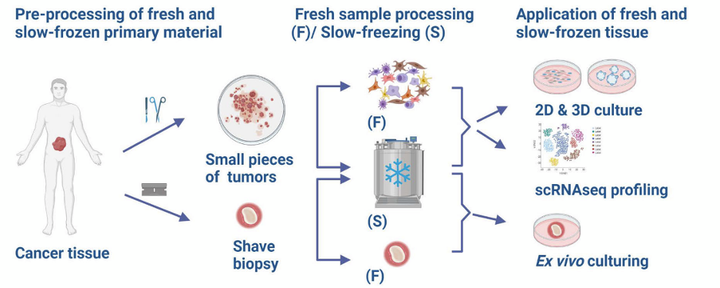
Assessing the utility of slow frozen patient samples Fresh samples are valuable for research. But very often, samples cannot be processed fresh and need to be stored frozen. In this study, we validated that human tumor tissues subjected to slow-freezing immediately after resection remain viable for various subsequent applications. Comparative single-cell RNA sequencing of fresh and slow-frozen samples (from melanoma, BCC, breast cancer and CRC) showed similar recovery rates and cell type compositions. Only minor signs of heat-shock (related to freezing) were observed. This confirms that slow-frozen biobanked material is suitable even for demanding assays like single-cell RNA sequencing and establishing 2D/3D cultures. (read more here: https://www.nature.com/articles/s42003-022-04025-0)
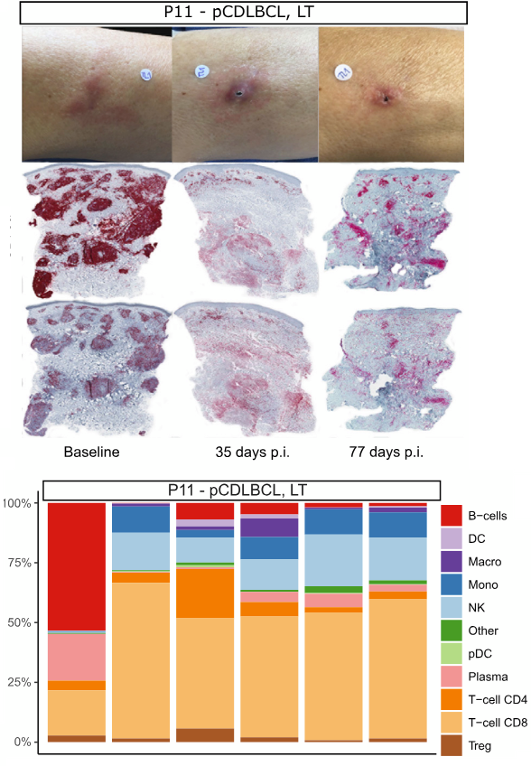
A single-cell view on virotherapy in B-cell lymphoma In this research project, we were able to work with fine-needle aspirates (in essence, a less invasive form of biopsy) of primary Cutaneous B-cell Lymphoma (pCBCL) patients who were recruited for a clinical trial investigating an oncolytic virotherapy called T-VEC. T-VEC is a genetically modified herpesvirus, which was specifically developed to eliminate cancer cells (hence oncolytic). At the time of the study, this treatment had already been approved for treating melanoma, and the trial investigated its efficacy in another skin cancer: pCBCL. Single-cell sequencing showed that T-VEC treatment was safe: the virus did not spread outside of the injected lesion and did not persist longer than a few days at the injected site. T-VEC induced rapid eradication of malignant cells and activates the systemic immune response, including the influx of Natural Killer cells and monocytes. Interestingly, we found that the virus did not selectively destroy malignant cells, but attacked healthy cells as well. However, by eliciting a strong antiviral response (which is similar to an antitumor response), T-VEC treatment was able to systemically activate immune cells which eradicated malignant cells even in remote lesions (far from where the virus was injected) (read more here: https://www.cell.com/cancer-cell/fulltext/S1535-6108(20)30670-X).